



BABIES’ SKIN: ITS MAIN FEATURES AND HOW TO CARE FOR IT
BABIES’ SKIN: WHAT ARE THE DIFFERENCES WITH ADULT SKIN?
As with all parts of the body,
babies’ skin changes from the first few months of their lives and continues as they grow. It must gradually become accustomed to contact with the air and lower temperatures, as well as how to protect itself from potential external stressors. Compared to adult skin, it differs in 3 main ways:
1. the epidermis is thinner. Specifically, the stratum corneum is thinner, which is the skin’s main “barrier”, thus the skin is more permeable to the dangers coming from external agents (irritants, allergens and pathogenic micro-organisms);
2. sebaceous secretion is as-yet inactive. Consequently, the hydrolipidic film is poorly developed precisely in the lipid section, i.e. the fat part, which is important for maintaining skin hydration;
3. skin pH is slightly higher. Thus the skin has less acid protection and buffering capacity. The skin’s pH also helps to protect it from hostile micro-organisms and if it rises, this can allow mycotic-bacterial infections to develop.
These characteristics indicate that the barrier function of the epidermis, i.e. its “shielding” ability is diminished and thus babies’ skin is subject to more dehydration, dryness and is more vulnerable to external stressors.
Fragile and immature, babies’ skin also needs special attention when exposed to the sun, because their melanocytes are not very active and therefore they have a lower ability to produce melanin.
1. the epidermis is thinner. Specifically, the stratum corneum is thinner, which is the skin’s main “barrier”, thus the skin is more permeable to the dangers coming from external agents (irritants, allergens and pathogenic micro-organisms);
2. sebaceous secretion is as-yet inactive. Consequently, the hydrolipidic film is poorly developed precisely in the lipid section, i.e. the fat part, which is important for maintaining skin hydration;
3. skin pH is slightly higher. Thus the skin has less acid protection and buffering capacity. The skin’s pH also helps to protect it from hostile micro-organisms and if it rises, this can allow mycotic-bacterial infections to develop.
These characteristics indicate that the barrier function of the epidermis, i.e. its “shielding” ability is diminished and thus babies’ skin is subject to more dehydration, dryness and is more vulnerable to external stressors.
Fragile and immature, babies’ skin also needs special attention when exposed to the sun, because their melanocytes are not very active and therefore they have a lower ability to produce melanin.
HOW TO TREAT BABIES’ SKIN
As it is more vulnerable, the fundamental daily care for babies’ skin - cleansing and protection - requires
specially formulated products to respect the delicate balance of the skin. Thus it is crucial that we know how to treat babies’ skin. Furthermore, it is important that we choose
cosmetics that are clearly indicated for children, without potentially irritating and/or sensitising ingredients, such as fragrance allergens or certain preservatives.
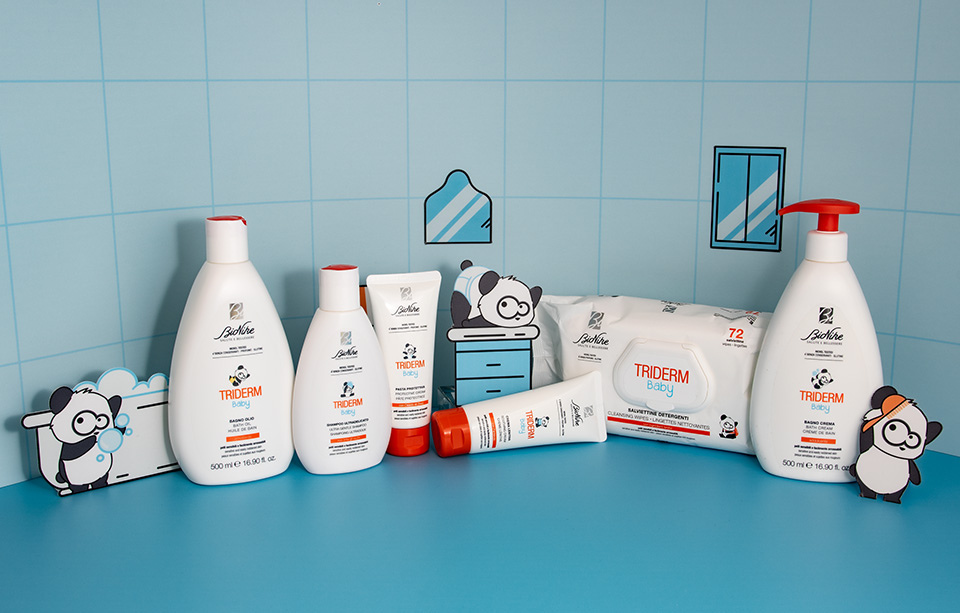
Cosmetics for newborns and babies fall into three main categories:
- cleansing products;
- protective products for the nappy area;
- emollient and hydrating products for the face and body..
Cosmetics for newborns and babies fall into three main categories:
- cleansing products;
- protective products for the nappy area;
- emollient and hydrating products for the face and body..


